GHG, Carbon & net zero advisory in Singapore

Singapore is rapidly strengthening its climate commitments and sustainability regulations. With evolving disclosure requirements and rising stakeholder expectations, businesses must take a structured, data-driven approach to greenhouse gas (GHG) management and net zero strategy.

Our GHG, Carbon & Net Zero Advisory in Singapore helps organisations measure, manage, and reduce carbon emissions while aligning with global standards and local compliance frameworks. From carbon accounting to full decarbonisation roadmaps, EcoSphere Sustainability Solutions Pte. Ltd. provides practical, results-driven solutions tailored to your industry.

Call For Consultancy: +60 11 6768 5759
GHG, Carbon & net zero advisory in Singapore

Why GHG & Carbon advisory matters in Singapore?

Singapore has introduced stronger sustainability disclosure requirements for SGX-listed companies. Climate reporting expectations are expanding beyond large corporations. The Singapore carbon tax framework also increases financial exposure for high emitters. Carbon is no longer just an environmental issue. It affects:

  • Regulatory compliance
  • Investor confidence
  • Supply chain relationships
  • Access to financing
  • Long-term operational resilience
Why ESG strategy matter for Singapore businesses

Our GHG & carbon advisory services in Singapore

EcoSphere Sustainability Solutions Pte. Ltd. is a reliable consultancy firm in Singapore. We provide end-to-end carbon advisory support, from baseline measurement to long-term transition planning.

GHG inventory & carbon accounting

GHG inventory & carbon accounting (Scope 1, 2 & 3)

We quantify greenhouse gas (GHG) emissions using internationally recognized methodologies. This is essential for compliance, sustainability, and reaching net-zero goals.

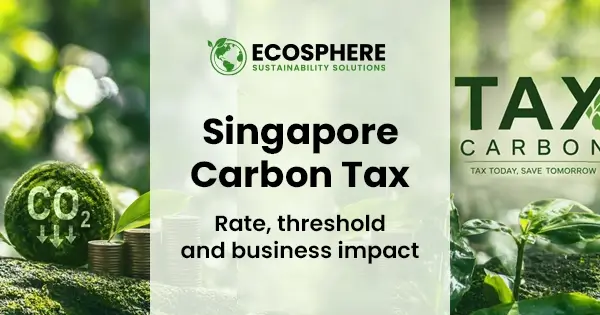
Singapore carbon tax advisory

Singapore carbon tax advisory

Singapore’s carbon tax framework impacts certain high-emission facilities and industries. Financial exposure can increase over time. We focus on energy efficiency projects & decarbonization strategies.

Net zero strategy & roadmap development

Net zero strategy & roadmap development

the skills they need to manage ESG smoothly.Singapore’s carbon tax framework impacts certain high-emission facilities and industries. Financial exposure can increase over time. We focus on energy efficiency projects & decarbonization strategies.

Climate risk & scenario analysis

Climate risk & scenario analysis

Climate risks affect asset valuation, financing, and long-term business continuity. We conduct a physical risk assessment, transition risk analysis, scenario modeling, financial impact mapping, and governance advisory.

Carbon reduction & energy efficiency solutions

Carbon reduction & energy efficiency solutionsg

We identify and prioritize carbon reduction initiatives such as renewable energy procurement, energy efficiency optimization, electrification strategies, and green building certification alignment.

Scope 3 & supply chain decarbonisation

Scope 3 & supply chain decarbonisation

Scope 3 emissions often account for 70–90% of the total carbon footprint. We assist in supplier engagement strategies, value chain mapping, and low-carbon procurement frameworks.

Industries we support in Singapore

Each industry has different emission drivers. For this reason, we tailor advisory support accordingly. Our GHG (greenhouse gas) and net zero advisory services are customized to:

  • SGX-listed companies
  • Financial institutions
  • Real estate and property developers
  • Manufacturing and industrial firms
  • Logistics and supply chain operators
  • Technology and data centres
  • SMEs preparing for sustainability reporting
Schedule A Meeting
Industries we support in Singapore

Regulatory & framework alignment

This ensures your reporting remains defensible and future-ready. Our advisory considers alignment with:

  • Singapore carbon tax regulations
  • SGX sustainability reporting requirements
  • MAS climate-related risk expectations
  • IFRS sustainability disclosure standards
  • International GHG accounting standards
Contact ESG Team
Regulatory & framework alignment

Our step-by-step advisory approach

We do not rely on just readymade templates. We know each business organization has different operational structures, data maturity levels, and regulatory exposure. The focus remains on practical, clear data, measurable targets, and structured reporting.

01
Initial carbon maturity measurement
02
Data mapping and collection planning
03
Strategy and goal setting
04
Strategic roadmap development
05
Implementation guidance
06
Implementation guidance and monitoring support

Why choose EcoSphere Sustainability Solutions Pte. Ltd. for GHG & net zero advisory?

EcoSphere Sustainability Solutions Pte. Ltd. is the most trusted consultancy firm for decarbonization in Singapore. We focus greatly on clarity, accuracy, and measurable outcomes.

  • Local expertise with global standards
  • Structured and defensible carbon accounting methodology
  • Practical net-zero planning, not theoretical commitments
  • Practical net-zero planning, not theoretical commitments
  • Clear documentation for audit and assurance
  • Long-term transition and end-to-end support
Schedule Consultation
Why choose EcoSphere Sustainability Solutions Pte. Ltd. for GHG & net zero advisory

Start your carbon & net zero journey with us

Carbon reporting is becoming standard practice in Singapore. If your business organization needs reliable GHG (greenhouse gas) measurement, carbon accounting, or a realistic net-zero roadmap, EcoSphere Sustainability Solutions Pte. Ltd. is here to help; contact our advisory team today. Let’s build a strategy that works in Singapore’s regulatory and business environment.

Get Your
Free Consultation

FAQs about GHG, carbon & net zero consultancy

What is GHG accounting in Singapore?

GHG accounting is measuring and reporting greenhouse gas emissions from your operations. In Singapore, companies calculate Scope 1, 2, and sometimes Scope 3 emissions based on global standards. This data supports sustainability reporting, carbon tax assessment, and investor disclosures.

Is carbon reporting mandatory for companies in Singapore?

For SGX-listed companies, sustainability reporting is required. Larger emitters also fall under Singapore’s carbon tax rules. Smaller businesses may not be legally required yet, but many are asked for carbon data by clients, banks, or multinational buyers.

How do I develop an ESG roadmap for my company?

Start with a materiality assessment to identify key risks and stakeholder concerns. Then define governance roles, ESG targets, and performance indicators. A phased roadmap with timelines and accountability is important.

What are Scope 1, Scope 2, and Scope 3 emissions?

Scope 1 comes from your own operations, like fuel burned on-site. Scope 2 relates to the electricity you purchase. Scope 3 covers emissions across your supply chain, which often turns out to be the largest portion.

How do I calculate my company’s carbon footprint in Singapore?

You start by identifying emission sources and collecting fuel, electricity, and operational data. Then, emission factors are applied using recognized calculation methods.

What is a net-zero roadmap?

A net-zero roadmap outlines where you are today and how you plan to reduce emissions over time. It sets clear milestones and identifies practical reduction steps. It also defines who inside the organization is responsible for delivery.

Does my SME in Singapore need a carbon consultant?

Most SMEs do not have an internal sustainability team. Data collection can be confusing at first. An advisor helps organize the process, ensure accuracy, & prepare documentation that clients or auditors may request.

How does Singapore’s carbon tax affect businesses?

If your facility crosses the emission threshold, the carbon tax applies. Rates are scheduled to increase progressively. This means early planning can reduce future financial pressure.

What is the Scope 3 emissions assessment, and why is it important?

Many global buyers and investors now look beyond direct emissions. They want visibility into supply chain impact. Without Scope 3 disclosure, sustainability reporting may appear incomplete.

How long does it take to develop a net-zero strategy?

The timeline greatly depends on company size and data readiness. For many organizations, initial carbon measurement takes a few months. Building a structured net-zero roadmap typically follows once the baseline is confirmed.

Can carbon offsets help achieve net-zero in Singapore?

Offsets may support the final stage of a strategy. However, most credible plans focus first on reducing operational emissions. Real reduction carries more long-term value than relying heavily on offsets.

Top