Singapore carbon tax 2026: Rate, threshold, and business impact
Singapore carbon tax 2026 is an increasingly important consideration for
businesses with
significant greenhouse gas emissions. As part of Singapore’s long-term decarbonization
strategy, the carbon tax rate has increased to S$45 per tonne of CO₂e for 2026 and
2027, up from S$25 per tonne in 2024 and 2025.
For companies operating energy-intensive industrial facilities, understanding the Singapore
carbon tax rate, emissions threshold, reporting requirements and available carbon-credit
options is essential for effective cost planning and regulatory compliance.
For affected businesses, the higher carbon tax can directly influence operating costs, energy
decisions and long-term investment planning. Companies that prepare early can better
understand their emissions exposure, identify practical reduction opportunities and build carbon
costs into future budgets instead of treating compliance as a last-minute exercise.
Singapore's carbon tax is a charge placed on facilities with significant direct
greenhouse gas
emissions. It operates under the Carbon Pricing Act (CPA) and was introduced in 2019. The idea is fairly
simple. A facility that produces more taxable greenhouse gas emissions faces a higher carbon
cost.
This gives businesses a practical reason to look at where emissions come from, how much energy
they use and whether older or inefficient systems can be improved. For larger industrial
facilities, carbon tax is therefore closely connected with energy efficiency, fuel use,
equipment performance and longer-term decarbonisation planning.
Singapore's carbon tax rate 2026
For businesses with high emissions, the difference can be significant. Carbon cost should
therefore not be looked at only when the tax becomes due. It also needs to be considered when
planning new machinery, energy contracts, factory upgrades and emission-reduction projects.
Singapore has also indicated a longer-term carbon price range of S$50 to S$80 per tonne by
2030. The carbon tax rates are:
Period
Carbon tax rate
2019–2023
S$5 per tCO₂e
2024–2025
S$25 per tCO₂e
2026–2027
S$45 per tCO₂e
By 2030
S$50–S$80 per tCO₂e target range
For emissions in 2026 and 2027, the applicable rate is S$45 per tonne of CO₂e. That is a
sizeable increase from the S$25 rate used in the previous two years.
What is the carbon tax threshold in Singapore?
The main taxable threshold is 25,000 tonnes of CO₂e in direct greenhouse gas emissions per
calendar year. When a facility reaches or exceeds this level, it is treated as a
taxable facility under the Carbon Pricing Act. There is also a lower level that
businesses should know about:
2,000 to below 25,000 tCO₂e: Reportable facility
25,000 tCO₂e or more: Taxable facility
So a facility does not need to reach 25,000 tCO₂e before emissions requirements become
relevant. A business may already have reporting responsibilities once its direct emissions reach
the lower threshold. Facilities that reach the relevant threshold also need to register under
the Carbon Pricing Act within the required timeframe.
How is Singapore's carbon tax calculated?
The final obligation depends on the facility's verified emissions and the rules that apply to
it. Eligible international carbon credits may also affect the final amount in certain cases.
Still, the basic calculation is useful for budgeting. A business can estimate what its current
emissions may cost and compare that figure against the investment needed to cut those emissions.
The basic calculation is straightforward:
Taxable emissions × carbon tax rate
Take a taxable facility producing 100,000 tonnes of taxable emissions in 2026. The basic
calculation would be:
100,000 tCO₂e × S$45 = S$4.5 million
For an energy-intensive plant, this shows how quickly carbon cost can become a serious operating
expense.
Who needs to pay Singapore's carbon tax?
Singapore's carbon tax mainly applies to industrial facilities producing at least 25,000
tCO₂e of direct greenhouse gas emissions in a year. Facilities producing 2,000 tCO₂e
or more but below 25,000 tCO₂e can still fall under emissions reporting requirements.
The important point is that carbon tax is not decided by company revenue, employee count or the
physical size of the business. Relevant sectors can include:
Manufacturing and manufacturing-related services
Electricity and gas supply
Water supply
Waste-management activities
Other high-emission industrial operations
A business below the taxable threshold may not need to pay carbon tax directly. But that does
not always mean there are no carbon-related requirements. The level of direct greenhouse gas
emissions from the facility is what matters. For that reason, companies with fuel-heavy or
energy-intensive operations should understand their emissions early rather than waiting until
they are close to the taxable threshold.
Singapore carbon tax compliance requirements
Taxable facilities need proper systems for measuring, recording and reporting their emissions.
The work is not limited to calculating a number at the end of the year. Below are the major
requirements:
1. Develop a monitoring plan
A taxable facility needs a monitoring plan. This sets out the facility's greenhouse gas emission
sources, relevant emission streams, calculation methods and the procedures used to maintain data
quality. A clear plan helps keep emissions calculations consistent from one reporting period to
the next.
2. Measure and monitor emissions
The business needs reliable information on its direct greenhouse gas emissions. That usually
means keeping proper records for fuel use, industrial activities and other relevant emission
sources. Poor data can create problems later, especially during reporting and verification.
3. Submit an emissions report
A taxable facility must prepare an emissions report for each reporting period. The report needs
to follow the approved monitoring plan. It also has to be verified by an accredited third-party
verification company before submission.
4. Appoint responsible personnel
A taxable facility must appoint at least one GHG manager. This person is responsible for
preparing and submitting the emissions report. The facility must also appoint at least one
Designated Representative. These two roles cannot be handled by the same person.
5. Pay the applicable carbon tax
Once emissions have been measured, reported and properly verified, the taxable facility needs to
meet its carbon-tax obligation under the Carbon Pricing Act. For businesses with large emissions
volumes, this needs to be included in normal financial planning rather than treated as a
last-minute compliance expense.
Business impact of Singapore's carbon tax 2026
The S$45 per tCO₂e carbon tax rate in 2026 can affect businesses in more ways than the
tax bill itself. For large industrial facilities, the impact is direct. Other companies may feel
it through electricity, materials, suppliers and general operating costs.
Higher operating costs
The most direct impact is cost. A facility with high emissions may see a noticeable increase in
carbon-tax exposure even if its production level stays the same. Businesses that rely heavily on
fossil fuels or energy-intensive industrial processes should therefore include carbon cost when
preparing budgets and forecasts.
Pressure to improve energy efficiency
A higher carbon price can make energy-saving projects more financially attractive. Reducing
unnecessary energy use can lower both utility costs and emissions. That may involve improving
equipment performance, reducing energy losses, changing operating schedules or replacing
inefficient machinery.
Singapore's Energy Efficiency Grant can also support qualifying energy-efficient equipment. The
shared information notes support of up to 70% for eligible SMEs and up to 30% for eligible
non-SMEs until 31 March 2027, subject to the scheme's requirements.
Increased need for carbon management
Businesses need to know where their emissions actually come from. Without reliable data, it is
difficult to estimate carbon exposure or decide which reduction measures should come first.
Carbon management is therefore becoming part of normal business planning, particularly for
companies with high energy use.
A company may not pay carbon tax directly and still feel the effect. Suppliers, manufacturers,
logistics providers or other business partners may face higher energy or carbon-related costs.
Some of that cost can move through the supply chain and eventually affect procurement prices. So
businesses below the taxable threshold should not automatically ignore carbon pricing.
Long-term investment decisions
Carbon cost can also change the way businesses compare equipment and technology. A cheaper
machine with high energy consumption may cost more over its working life than a more efficient
alternative. This becomes more relevant as carbon prices increase.
Businesses planning new factories, equipment replacement or major energy systems should
therefore look at both upfront cost and long-term energy and carbon exposure.
Can businesses use carbon credits?
Singapore allows taxable facilities to use eligible International Carbon Credits (ICCs)
to offset up to 5% of taxable emissions, subject to the requirements of the ICC
Framework. Businesses considering credits can also review our carbon trading
program for support with carbon-credit assessment, offset planning and carbon exposure.
Carbon credits can be useful, but they should not become the whole strategy. A business still
needs to look at what can be reduced inside its own operation. Energy efficiency, equipment
upgrades and process improvements can deliver longer-term reductions that credits alone cannot
provide.
How can businesses reduce carbon tax exposure?
There is no single solution for every facility. A factory with large combustion emissions will
need a different approach from a business where most energy use comes from cooling or electrical
equipment. Still, several steps are useful for most companies.
Conduct an emissions assessment
Start with the current position. Identify major direct emission sources and work out whether the
facility is below, close to or already above the relevant reporting and taxable thresholds. This
gives the business a proper baseline.
Improve energy efficiency
Check where energy is being wasted. Old equipment, unnecessary operating hours, poor controls
and inefficient production processes can all increase both cost and emissions. Sometimes the
first useful reduction measures are quite practical.
Consider renewable energy
Businesses can assess lower-carbon or renewable energy options where they are technically and
commercially suitable. The right choice depends on the facility, energy demand and existing
systems. It should be based on real operational needs rather than simply choosing a technology
because it looks good in a sustainability report.
Modernise industrial equipment
Older boilers, chillers, motors, compressors and other industrial systems can use more energy
than necessary. Replacing or upgrading these systems may reduce operating costs and emissions at
the same time. The investment needs to be assessed against expected energy savings, carbon
savings and equipment life.
Establish carbon cost forecasting
Businesses should not calculate carbon cost only for the current year. It is useful to model
what happens under different emission levels and future carbon prices. This can help management
compare the cost of doing nothing against the cost of investing in reduction measures.
Strengthen emissions data management
Reliable carbon planning starts with reliable data. Businesses should know who owns the data,
where supporting records are kept and how calculations are checked. Good documentation also
makes verification and climate
reporting easier later.
Why start planning for Singapore's carbon tax 2026 now?
The 2026 rate is already much higher than the S$25 per tonne rate used in 2024 and 2025. At the
same time, Singapore has indicated a longer-term carbon price range of S$50 to S$80 per tonne by
2030. For a business with high emissions, waiting can make future decisions harder and more
expensive. Starting early gives the company more room to:
Identify its largest emission sources
Estimate carbon-tax exposure
Improve energy efficiency
Review low-carbon technology options
Assess eligible carbon credits
Improve emissions reporting
Build a longer-term decarbonisation plan
Include carbon cost in investment decisions
Not every change needs to happen at once. The useful starting point is understanding where the
business stands today and which actions will make the most significant difference.
Singapore carbon tax compliance and advisory services
Knowing the carbon tax rate is one thing. Managing the data, reporting requirements and
reduction opportunities is another. EcoSphere Sustainability Solutions Pte. Ltd. supports businesses with Singapore
carbon tax planning, emissions assessment, carbon
accounting and ESG reporting, compliance preparation and decarbonization strategy.
The work can start with a basic review of current emissions and facility thresholds. From there,
businesses can identify reporting gaps, estimate future carbon costs and look at practical ways
to reduce emissions. Support can include:
Carbon tax exposure assessment
GHG emissions measurement
Carbon accounting
Emissions data review
Monitoring and reporting preparation
Energy-efficiency assessment
Decarbonisation planning
Carbon-credit review
Carbon cost forecasting
Longer-term sustainability planning
Choose EcoSphere Sustainability Solutions Pte. Ltd. for carbon tax reduction in Singapore
Carbon tax planning needs more than checking a rate and multiplying it by emissions.
EcoSphere Sustainability Solutions Pte. Ltd. is a trusted carbon tax-reducing
company in Singapore. Businesses also need reliable data, clear reporting processes, and
a realistic plan to reduce future carbon costs.
Practical carbon tax guidance: Carbon tax can feel complex when emissions, compliance
and cost planning are handled separately. We help businesses focus on what matters most.
Emissions assessment: We review key emission sources to identify where reduction
efforts can have the most impact.
Compliance support: We help organize the records, monitoring and reporting needed for
smoother carbon tax compliance.
Decarbonisation planning: We identify practical ways to reduce emissions through
energy, equipment and operational improvements.
Business-focused solutions: We consider costs, operational needs and long-term carbon
exposure so the plan is realistic and usable.
Reduce your carbon tax exposure with a practical plan
Carbon tax planning should start before the final bill is calculated. A clear view of your
emissions, reporting gaps and reduction opportunities can help your business make better
decisions. EcoSphere Sustainability Solutions Pte. Ltd. provides carbon tax advisory in Singapore, covering
emissions assessment, carbon accounting, compliance preparation and decarbonisation planning.
Singapore carbon tax rules can seem confusing at first, especially with the higher 2026 rate
and different reporting thresholds. These FAQs cover the common questions businesses ask
about tax rates, eligibility, reporting, carbon credits and ways to manage future carbon
costs.
How can businesses reduce carbon tax costs in Singapore?
Businesses start by finding where most of their direct emissions come from.
Improving energy efficiency, upgrading old equipment and optimising industrial
processes can cut both energy use and taxable emissions. For eligible taxable
facilities, approved International Carbon Credits (ICCs) may also offset part
of the taxable emissions. The bigger goal, though, is to reduce emissions at the
source and keep future carbon costs under better control.
Does every business in Singapore pay carbon tax?
No. Most small and medium businesses do not pay the tax directly because they do not
reach the taxable emissions threshold. They may still feel some indirect impact
through electricity, materials or supplier costs.
What is the carbon tax rate in Singapore by 2030?
Singapore has stated a longer-term direction of S$50 to S$80 per tCO₂e by
2030. The government reviews the carbon-tax trajectory as conditions change,
so businesses should keep future rates in mind when making long-term investments.
Can companies use carbon credits to reduce Singapore carbon tax?
Yes. Taxable companies can use eligible International Carbon Credits (ICCs)
to offset up to 5% of their taxable emissions, subject to Singapore's rules and
eligibility requirements.
What is a reportable facility under Singapore's Carbon Pricing Act?
Facilities with annual direct emissions of 2,000 tCO2e or more may be subject to
reporting requirements. Reportable facilities need to submit an Emissions Report and
appoint the required personnel even if they remain below the taxable threshold.
What are the carbon tax reporting requirements in Singapore?
Taxable facilities shall be required to have a Monitoring Plan and submit an
Emissions Report for each reporting period. The report shall be prepared in
accordance with the approved plan and verified by an accredited third-party
verification company.
Berapakah kadar cukai karbon Singapura pada 2026?
Kadar cukai karbon Singapura ialah S$45 bagi setiap tan CO₂e untuk tahun 2026
dan 2027. Kadar ini naik daripada S$25 bagi setiap tan pada 2024 dan 2025.
Siapa yang perlu membayar cukai karbon di Singapura?
Cukai karbon dikenakan kepada kemudahan industri yang menghasilkan
sekurang-kurangnya 25,000 tCO₂e pelepasan gas rumah hijau secara langsung
setahun. Perniagaan di bawah paras ini biasanya tidak membayar cukai secara
langsung.
Prepare for Singapore carbon tax
Get expert support for Singapore carbon tax planning, emissions data, reporting, and carbon
compliance.
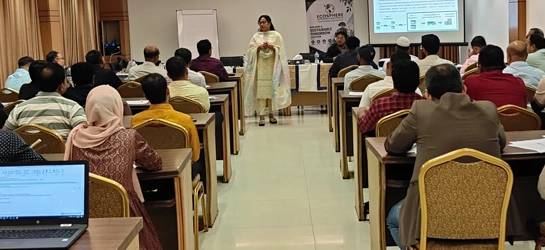
We developed a comprehensive corporate event communication campaign that combined professional visual design with clear and structured training information. The design was created to effectively communicate the importance of SBTi, GHG accounting, sci...
Expert structured carbon trading program in Singapore? We offer carbon tax advisory, credit sourcing, compliance support, and net-zero transition planning.
Expert GHG, carbon accounting & net zero advisory in Singapore. Align with ISSB, SBTi & local regulations. Build credible decarbonization roadmaps today.



 +65 8589 4661